
McGrath and the 90s

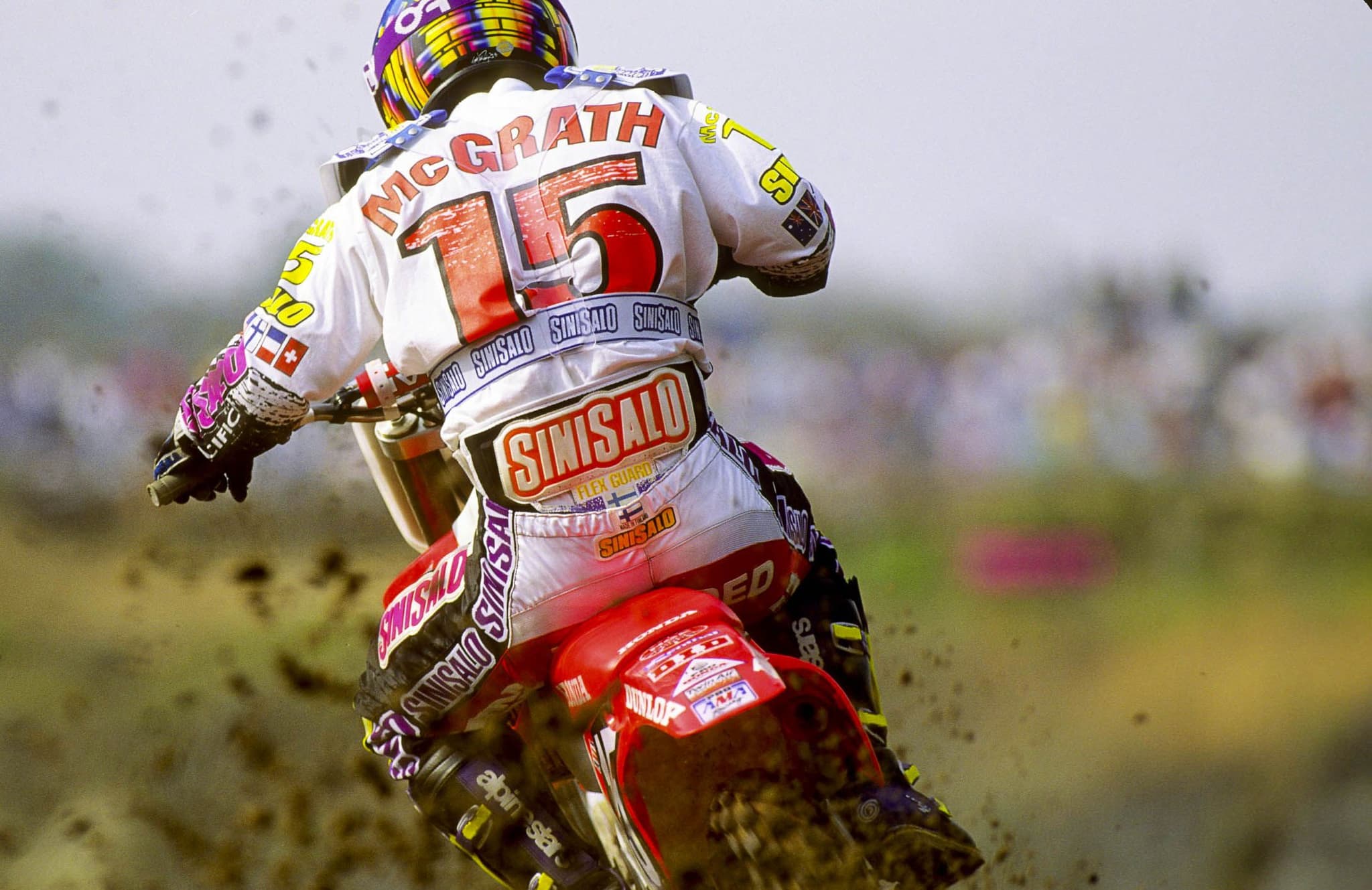
On Saturday night, March 17, 1990 – and before a high school football-size crowd in the then tiny Las Vegas Silverbowl – this reporter watched a kid from Southern California named Jeremy McGrath ride his #125 Team Green Kawasaki KX125 to victory in the final race of the 1990 AMA Supercross tour.
Eric Johnson Interview
Fast forward to the October of 2026 where seven-time AMA Supercross takes a moment to reflect back on the very first supercross victory of his career.
“You know what?” asked McGrath. “I have a memory of the night itself. But the Vegas race was in March that year?”
“Yes it was,” replied this writer.
“Wow, that’s wild because usually Vegas was sort of the last round of the season, right?”
“Exactly.”
“Vegas tracks always suited me because it was exactly like what I grew up riding on – just shitty hardpack, dusty and slippery,” explained McGrath of the Las Vegas baked hardpack circuit he competed on that evening. “It was exactly like when I used to ride my dirt bike off of Newport Road when I was a little kid. And then when I first started getting the big bikes and stuff, we still rode there a ton and the Vegas supercross track was just like that. For me, the Las Vegas race, it was cool. I mean of course to get your first win in Vegas was awesome. I was still riding Loretta Lynn’s in 1990. That’s when you could race Loretta Lynn’s and still race supercross, like West Coast 125 and not be considered a legitimate Pro. You could still ride A class. The structure was quite a bit different. There was a lot more undeveloped riders in the class, like myself. You could kind of get in there and get your teeth wet. You were kind of Pro, but you weren’t Pro yet. It was kind of one of those situations. But I mean I think when I won that race, it was like I captured lightning in a bottle and I was like, ‘Okay, I guess I can do that again.’ I think for the rest of the year I did fairly well, but Ty Davis won the championship and I didn’t. Davis won San Diego and I won at Las Vegas. That was it. One race.”
And it was an important triumph for the Team Green racer.
“More importantly, that win just kind of probably kickstarted Dave Arnold and Ricky Johnson and any of the boys at Honda in looking at me,” explained McGrath. “They were looking for the new kid. Remember, when I signed at the end of that year with Honda, it was kind of before the new Pro Circuit Peak Honda was developed. I famously said in some interviews in the past that when I signed with Honda, I was like, ‘Alright, I’m big time. I finally made it. This is pretty awesome. I’m going to be right next to Bayle and Stanton and all my heroes.’ Pro Circuit, and what Mitch Payton built and what Honda supported and all that was monumental, you know? It was the best decision to go there. I mean I was very lucky to be on that very first team.
“I was happy. I was just a kid at 19 years old. I felt like I had the world in the palm of my hand,” continued McGrath. “I still had so much to learn. I mean think about it. I didn’t start racing until mid-1986. Three and a half years of racing and I was already on a factory team. It was a real steep learning curve. Real steep. And I’ve said this 100 times, too, I didn’t really know how to ride motocross. I knew that I would do well in supercross, but I didn’t really know how to ride motocross. I didn’t have that level of commitment and dedication and discipline to ride outdoors. Even in 1990 when I was riding that Kawasaki, I raced Hangtown. I got 39th overall. I was so bad. Remember, I was on Team Green with Ryan Hughes at the same time. Ryan and I raced our first nationals together and Ryan got seventh overall at Hangtown. I was like, ‘Holy shit! I’m in the deep water now!’ Even then it was alarming to me, but I wasn’t so alarmed that I would go out and work on it. I just worked on my supercross skills. Famously, it took me until 1994. I had one premier supercross title down and that end of 1993 was when I committed myself to figure out how to race outdoors because I just got tired of getting beat. And then all the media was talking that I would never be considered one of the great guys because I suck at motocross. I was still getting thirds and fourths.”
Mentoring and coaching McGrath at this point in his career was Gary Semics. A top 10 racer in the AMA 500cc National Championship, as well as competitor in the 500cc World Championship, Semics and his insight and knowledge was of terrific importance to McGrath.
“I had the help of Gary Semics,” said McGrath. “Gary Semics was a huge mentor to me. He was my only coach in riding. He was the guy that I had throughout my career. He really just knew how to get me going and sort of do it in a way that was motivating and not demoralizing. Gary Semics was a very instrumental in really just getting my mind right. You know what I mean? We came up with this thing that was, ‘Hey, if you’re gong to be there and you’re going to spend your time doing this, you might as well do it right.’ It was a lot of the same things my dad taught me, too. It was like, ‘Dude, if you’re going to be there and you’re going to put the time in, and there is going to be one winner, it might as well be you. Otherwise you’re wasting your time.’ That was kind of the mantra that we went with for years and years. Gary was really instrumental in getting me to consider those things and finding a way to be disciplined and really retrain my thoughts on what it means to be a pro, what it takes to be a pro and what it is to disciplined.
“When you’re a kid and a pro, you’re not really a professional. Yet. You’re racing pro, but you’re not doing things that pros do and men do. It was really just kind of figuring out that combination. Luckily, supercross was SO fun and I was so good at it that I just kept motivated to really get in the trenches.”
Brought into the Team Honda works program for 1993, McGrath graduated to the premier AMA/Camel Supercross Series classification.
“1993 comes along and I’m moving up to the factory team. I remember reading in my contract that they had a top three bonus for me and I was like, ‘Oh man! I don’t know if I can even get top three! I’m racing my heroes and the baddest dudes in the sport. I was like, ‘Can you make my bonuses through fourth place? Can you lessen my first place bonus and spread it out through fourth place’ They said, ‘Yeah, we can do that.’
“Then lo and behold, I start winning every race after a couple of races. Anyway, I like to laugh about it. I won 48 supercross races for Honda at $8,000 a bonus win. I won two supercross races at Suzuki for $50,000 a win. When I left Honda and went to Suzuki, a bonus to win was $50,000. Then I won 28 races on the Yamaha and the bonus rate was the same. It was $50,000 to win a supercross.
“With Honda going into 1993, I mean there was a level of doubt there. But here’s the thing: At the supercross track that year, we were still in Simi Valley and the track was gnarly. It was a John Savitzky built and designed track. It was SO gnarly.”
“So Jeff Stanton was the main guy at Team Honda, right? He was the main dude. During the leadup to supercross that year, I was crushing these guys on the practice tracks. Even though there was a level of doubt in there. But they knew it was coming. I wasn’t sure it was coming, but I felt like it at the practice track, for sure. It was all the way there. And then I just needed the stars and everything to line up to get it going.”
“In the first few races, at Orlando I finished fourth and the next week at Houston I was fifth. At the Hoston race, my bike never felt right. Skip [Norfolk] had my handlebar mounts on backwards. I was not smart enough to let him know and say, ‘Hey, this thing s kind of messed up.’ We famously figured out after the race that, ‘Shit, My bike wasn’t right.’ And then we fixed it and the Anaheim race happened the next week .I don’t know, man… It was just kind of the stars were lining up and things were starting to work out right. The rest is history, right? After I won at Anaheim, it was on.”
Does McGrath still reflect back on the all-important Anaheim race?
“Yeah, I remember that night like it’s tattooed into my brain. Absolutely. I remember that night like crazy because it was a really weird mind game to think I was going to pass Stanton because Stanton was my hero! It was a little bit of a mind game, but I do remember the pass. He went wide and left the door open on the inside of that single and I was like, ‘Okay, here it is. It’s presenting itself. I’ve got to take it.’ From there I just kind of took off and I won by a ways. I took off and smoked them. Once I did it once, I was like, ‘Oh shit. This ain’t bad, this is easy.’”
And McGrath could feel the buzz of his popularity continuing to spool up.
“Yeah, I did feel that. I especially felt that all coming on when I was on the 125 because I was dominating supercross. I could feel it. I mean that feeling is kind of like magnetic, right? It starts to happen and it was like, ‘Whoa. This is crazy.’ It all kind of suited my style. I liked it. Who is not going to like that?. I didn’t feel out of place with the popularity coming on and all that stuff. It was all natural and I felt right at home.
“Beating Stanton was weird. Of course I was in shock. Even after I won it was still a little bit weird because Stanton was one of my heroes. I almost felt bad. I did win the race, but the stars lined up pretty good. I got a good start I had a nice line. I still couldn’t believe that it could happen that easily. I was soon to find out that I could do that every week. That was pretty amazing. I do remember Stanton at the test track the rest of the year. He had succumbed to the fact that I was there and his reign was over.”
And McGrath powered forward, gliding to the 1993 AMA/Camel Supercross Series championship.
“Man, it honestly was an actual dream coming true. It really was. At first, it was like, ‘No way. This is so cool.’ Then it was like, ‘Wow, I can do this. I can this week-in and week-out.’ After winning a few of those races, I felt pretty unstoppable. I felt like I could win every week, no problem. It was like it was supposed to happen, you know?”
And along the way, McGrath could feel the reality of his completive surroundings.
“I think in the older guys, it was like a sense of defeat. The younger guys, my class of guys, my age group guys, they were all like, ‘Holy shit! How are you doing this?’ They were very surprised. They were surprised that I won a number of races in a row after the first one. I guess everyone had the right to be surprised. I kind of took it by storm and I completed the job. I mean I got the title. My first year out on the big bike, I smash the single season win record and I won the title.”
Not only was McGrath winning and dominating at this point, he was also enjoying himself and simply having fun.
“I was having fun. It was easy to look that way, though, because the old dogs were not having fun and they didn’t look like they were having fun. They were the guys that had to hate their competitors. I kind of changed that narrative. I was more like, ‘Hey, I’m riding with all my buddies and all my buddies are racing with me on the weekends and we’re finishing top three and then we’re out having drinks afterwards and we’re scamming on the girls and we’re having so much fun!’ It was always very weird to me that these old guys would hate each other. I think it started with Bob Hannah. Bob just hated his competitors. That was just so strange to me. What I was doing was being a kid. I was being a kid in a man’s world but also trying to mix a little fun in it.”
As McGrath continued to take control of the sport, his winning ways and natural born showmanship was helping nudge the sport into the mainstream.
“I felt it, I guess,” nodded McGrath. “Not back then or even now, I’m not trying to take any credit for the growth of the sport, but when you win a lot of races like that, people start to notice. And it’s not our insiders that notice. It’s people outside the sport. That’s what makes the sport more popular. You wouldn’t know Jeremy McGrath’s name from anybody if I won three races that year. But if you win 10 races as a rookie, people start talking like, ‘Who is this guy? What’s going on over there in that sport?’ The same thing happened when Jeff Gordon or Jimmie Johnson came along. The only way we ever made SportsCenter, and the one time I made it onto SportsCenter in my life was because I won 10 races in a 15-race season. It automatically kind of goes without saying that the sport was kind of launched on my back for those years because it was kind of in a little bit of a stall point. I was happy to take on that role, but it needed a guy like me.”
Anyone racing in 2026 remind McGrath of himself?
“Not really. I think the Lawrences have gotten a little better within their interviews and stuff,” said McGrath.
And his take on the omnipresent Haiden Deegan?
“Yeah, I mean I think Haiden is probably the one that would remind me of me the most, right?” offered McGrath. “I would some of the stuff he does is a little outlandish. So far, he’s backing it up. That kind of self-promotion and confidence, that stuff really works. But he’s gonna have to start winning, though. Otherwise it’s just all talk.
“I think he’ll do fine on the big bike, but he still has a lot to learn when you watch his technique,” continued on McGrath. “Look, I’m a fan of all the self-confidence. I love to walk the line of confident and not arrogant. Walk right in the center of that. And it’s even better when you can back it up, which he’s done. He’s pretty unbelievable. I will say that. He’s got a few things that he needs to learn. He can learn it from the Larence brother by just riding near them or watching them. Instead of talking so much, he can be listening and watching. Yeah, I mean he’d be a guy that would remind me of myself. He could launch the sport into a whole other stratosphere. Especially if he starts winning. He’s already the most popular guy by a lot. Now if he can just win to sort of back that reputation up, it’s going to really set him up. He’s on his way. He’s already got the stardom. He’s on his way to superstardom. He’s just got to find a way to beat these guys. He’s going to have to beat the Honda boys and then he’s going to have to beat Cole Davies when he comes. It’s not going to get any easier. And him and Jett Lawrence are going to race each other for a long time.”
Interestingly, it was the idea of losing that helped keep the Californian motivated and charging along the way.
“Of course I hated losing. What kept my mind in the game was always thinking I was going to lose. I was always thinking that there was the next guy and the next guy and the next guy. I really considered myself being the underdog. I just really trained my mind to believe that you can never get content. You have to be ready all the time. man, for a lot of years it worked. For nine or 10 years it worked. For 10 seasons, I won more races than all the other riders in the world combined that were competing against me. That’s pretty insane. That’s a gnarly stat right there.”
In many ways the start of the McGrath era in the sport, does the seven-time supercross champion still look back on the brilliant 1993 title march?
“For sure. For sure. That’s just the one that always comes up because it’s just tattooed into my memory. The first one is aways the one that all the doubters said you can never get. It’s the one you told yourself you might never get. The first one is always real special because it’s just seems like you’ve done the impossible. Yeah, I’d say the first one was just such a memorable year. What I am really proud of is that I was able to do this professional sport at the highest level and maintain my personality and just be me. I’m just so proud that I was able to maintain that sort of image of me just being me. All I did was just try to be me. Luckily in this sport it was accepted worldwide.”